
Smart PDS 2.0 Portal: New Digital Platform for Ration Card Services Across India
Home Central Schemes Smart PDS 2.0 Portal: New Digital Platform for Ration Card Services Across India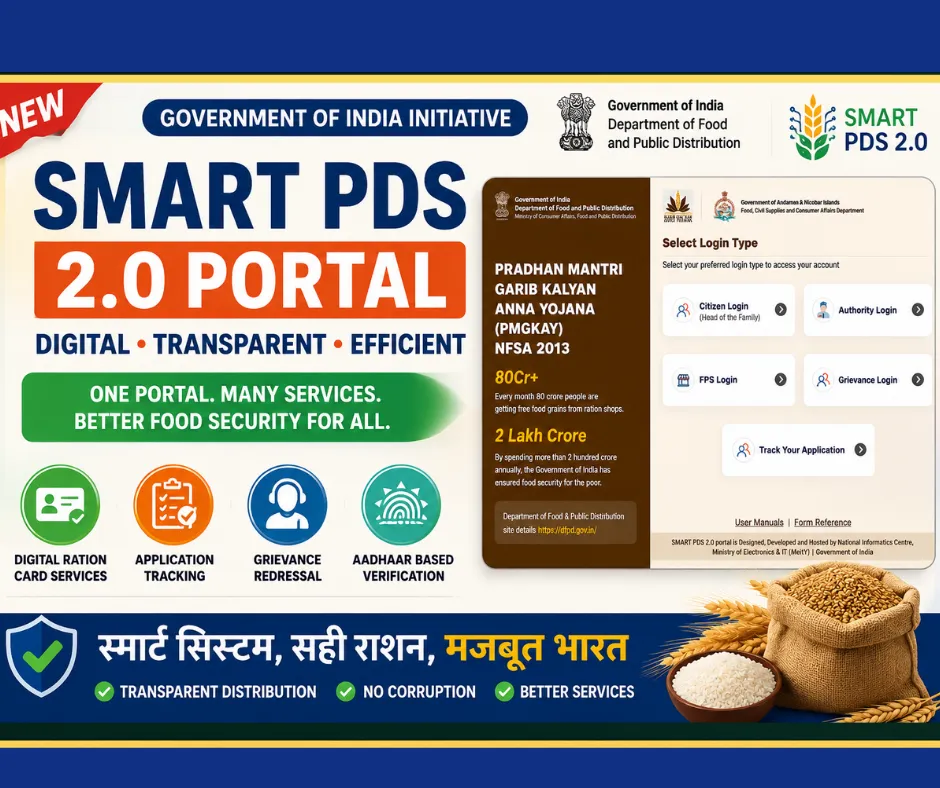 Published on Jun 04, 2026
Smart PDS 2.0 Portal: New Digital Platform for Ration Card Services Across India
Smart PDS 2.0 Portal: India's New Digital Platform for Ration Card Services and Food Distribution
The Government of India is gradually modernizing the Public Distribution System (PDS) through digital technology and integrated citizen services. As part of this transformation, the Smart PDS 2.0 Portal has been introduced as a centralized platform that aims to simplify ration card management, grievance handling, beneficiary services and food grain distribution across the country.
The portal brings multiple stakeholders—including ration card holders, Fair Price Shop (FPS) dealers and government authorities—onto a single digital ecosystem. Through this initiative, citizens can access various ration-related services online while improving transparency and accountability in the food distribution network.
What is Smart PDS 2.0 Portal?
Smart PDS 2.0 is a technology-enabled platform developed to strengthen India's Public Distribution System under the Department of Food & Public Distribution.
The portal serves as a common gateway for managing ration card services, beneficiary verification, application tracking, grievance registration and distribution monitoring.
The broader objective is to reduce manual processes, improve service delivery and ensure that food subsidies reach eligible beneficiaries efficiently.
Key Objectives of Smart PDS 2.0
The Government aims to achieve several goals through this digital platform:
- Digitize ration card-related services
- Improve transparency in food grain distribution
- Enable online citizen services
- Strengthen grievance redressal mechanisms
- Reduce duplicate and incorrect beneficiary records
- Promote Aadhaar-based authentication and verification
- Create a unified technology framework for PDS operations
Major Features of Smart PDS 2.0 Portal
-
Online Ration Card Services
The portal is designed to provide various citizen-centric services digitally.
Users may be able to:
Apply for a new ration card
Request modifications in existing records
Add or remove family members
Update address and other details
Track service requests online
This can significantly reduce dependency on physical visits to government offices.
-
Citizen Login System
A dedicated Citizen Login section is available for ration card holders.
Through this module, beneficiaries can access their personal records, submit service requests and monitor application progress.
The platform is designed to provide a more convenient user experience for households receiving food subsidies.
-
FPS Dealer Management
Fair Price Shop dealers play a crucial role in the ration distribution process.
The FPS Login section allows authorized dealers to manage distribution-related activities through a secure digital interface.
This may help improve operational efficiency and record management.
-
Online Grievance Redressal
One of the important features of Smart PDS 2.0 is its grievance management system.
Citizens can report issues such as:
Non-receipt of ration
Short distribution of food grains
Dealer-related complaints
Service delays
Verification-related concerns
Digital complaint registration may help authorities respond more efficiently.
-
Application Tracking Facility
Applicants can track the status of their requests directly through the portal.
This feature provides greater transparency and allows citizens to monitor the progress of applications without repeated office visits.
Role of Aadhaar-Based Verification
The Smart PDS 2.0 framework supports Aadhaar-enabled verification processes to strengthen beneficiary authentication.
Potential benefits include:
- Improved accuracy of beneficiary databases
- Reduction of duplicate records
- Enhanced transparency in subsidy delivery
- Better targeting of eligible households
- OTP-based authentication and digital verification mechanisms may further improve security and service reliability.
How Smart PDS 2.0 Supports Food Security
India's Public Distribution System serves one of the largest food security networks in the world.
Through initiatives linked with:
Pradhan Mantri Garib Kalyan Anna Yojana (PMGKAY)
National Food Security Act (NFSA) 2013
the government continues to provide subsidized or free food grains to eligible beneficiaries.
The Smart PDS 2.0 Portal is expected to strengthen these efforts by introducing digital monitoring and citizen-focused services.
Benefits of Smart PDS 2.0 Portal
- Improved Transparency
- Digital records and online monitoring can help reduce administrative inefficiencies.
- Faster Service Delivery
- Citizens may access various services without lengthy paperwork or multiple office visits.
- Better Complaint Resolution
- Online grievance submission can make issue reporting easier and more organized.
- Enhanced Beneficiary Verification
- Digital authentication systems may improve the accuracy of beneficiary records.
- Convenient Application Tracking
- Users can check service request status online at any time.
Benefits for Ration Card Holders
The portal may offer several advantages for beneficiaries:
- Easy access to ration-related services
- Reduced paperwork
- Faster updates to beneficiary records
- Improved communication with authorities
- Greater visibility into application status
Benefits for All States
All States depend on ration card benefits, may gain additional advantages from a centralized digital system.
Beneficiaries could experience improved service delivery, easier grievance registration and more transparent distribution mechanisms. Aadhaar-based verification and digital monitoring may also help reduce irregularities and improve accountability within the food distribution network.
As digital infrastructure expands, such integrated platforms can support smoother coordination between beneficiaries, dealers and government departments.
Important Details of the Portal
| Details | Information |
|---|---|
| Portal Name | Smart PDS 2.0 Portal |
| Managed By | Department of Food & Public Distribution, Government of India |
| Ministry | Ministry of Consumer Affairs, Food & Public Distribution |
| Category | Public Distribution System (PDS) |
| Coverage | All States and Union Territories of India |
| Beneficiaries | NFSA and PMGKAY Ration Card Holders |
| Estimated Beneficiaries | 80+ Crore Citizens |
| Login Types | Citizen Login, FPS Login, Authority Login, Grievance Login |
| Main Services | Ration Card Services, Grievance Registration, Application Tracking |
| Verification Method | Aadhaar-Based Authentication & OTP Verification |
| Related Schemes | NFSA 2013 & PMGKAY |
| Official Portal | https://an.smartpds.nic.in/ |
| Department Website | https://dfpd.gov.in/ |
Frequently Asked Questions (FAQs)
Q1. What is Smart PDS 2.0 Portal?
It is a centralized digital platform designed to support ration card services, grievance management and food distribution-related operations.
Q2. Who can use the portal?
Ration card holders, FPS dealers, government authorities and grievance users can access different sections of the platform.
Q3. Can citizens track applications through the portal?
Yes. The portal provides a facility to track the status of service requests and applications.
Q4. Does the portal support Aadhaar verification?
Yes. Aadhaar-based authentication is part of the broader digital framework to improve beneficiary verification.
Q5. What services are available on Smart PDS 2.0?
The platform supports ration card services, beneficiary management, grievance registration, application tracking and distribution-related functions.
Conclusion
Smart PDS 2.0 Portal represents an important step toward the digital transformation of India's Public Distribution System. By bringing citizen services, beneficiary verification, grievance handling and distribution management onto a single platform, the government aims to improve efficiency and transparency throughout the ration ecosystem.
As the platform continues to evolve, it has the potential to make ration-related services more accessible, accountable and user-friendly for millions of beneficiaries across the country.